GSM Roofing logo
800-532-7663 GSM Industrial logo Contact Us

Commercial Single-Ply Roofing: TPO, EPDM, and PVC Systems

A single-ply roof is one sheet of membrane, somewhere between 45 and 90 thousandths of an inch thick, standing between the building and the weather. Whether it lasts 20 years or 30 is decided before the first roll is opened: which membrane, how thick, how it is attached, and what is underneath it.

GSM Roofing has installed single-ply roofs across Pennsylvania, New Jersey, Delaware, and Maryland since the systems first came to market, and we have been a family-owned company in Ephrata since 1946. We hold Elite Contractor status with Sika Sarnafil, Master Contractor status with Elevate, GAF GoldElite Commercial Contractor status, and more than 1,000 Perfect 10 installations with Carlisle SynTec, and we install Johns Manville, Versico, GenFlex, and Duro-Last systems as well. Those credentials are what let us register the manufacturer warranty on your roof. The full list is on our manufacturers page.

TPO, EPDM, or PVC: Which Membrane Fits Your Building

All three are single-ply membranes, and all three can give you a 20-year roof. They differ in what they shrug off. The question we ask first is what the roof will be exposed to: sun, foot traffic, rooftop equipment service, grease, chemicals, or standing water.

MembraneWhere it fits bestSeamsThickness we typically installWarranties available
TPOWarehouses, manufacturing, offices, schools. White and reflective.Heat-welded60 mil standard, 80 mil for heavy traffic or hail20-year system warranties
EPDMBuildings that want the longest track record and the thickest sheet. Black or white.Adhered with seam tape, or fully adhered field60 mil standard, 90 mil for 30-year assemblies20- and 30-year assemblies
PVCKitchens, restaurants, labs, and roofs that hold water or see chemicals.Hot-air welded60 mil, often fleece-backed and fully adhered20-year system warranties

TPO roofing

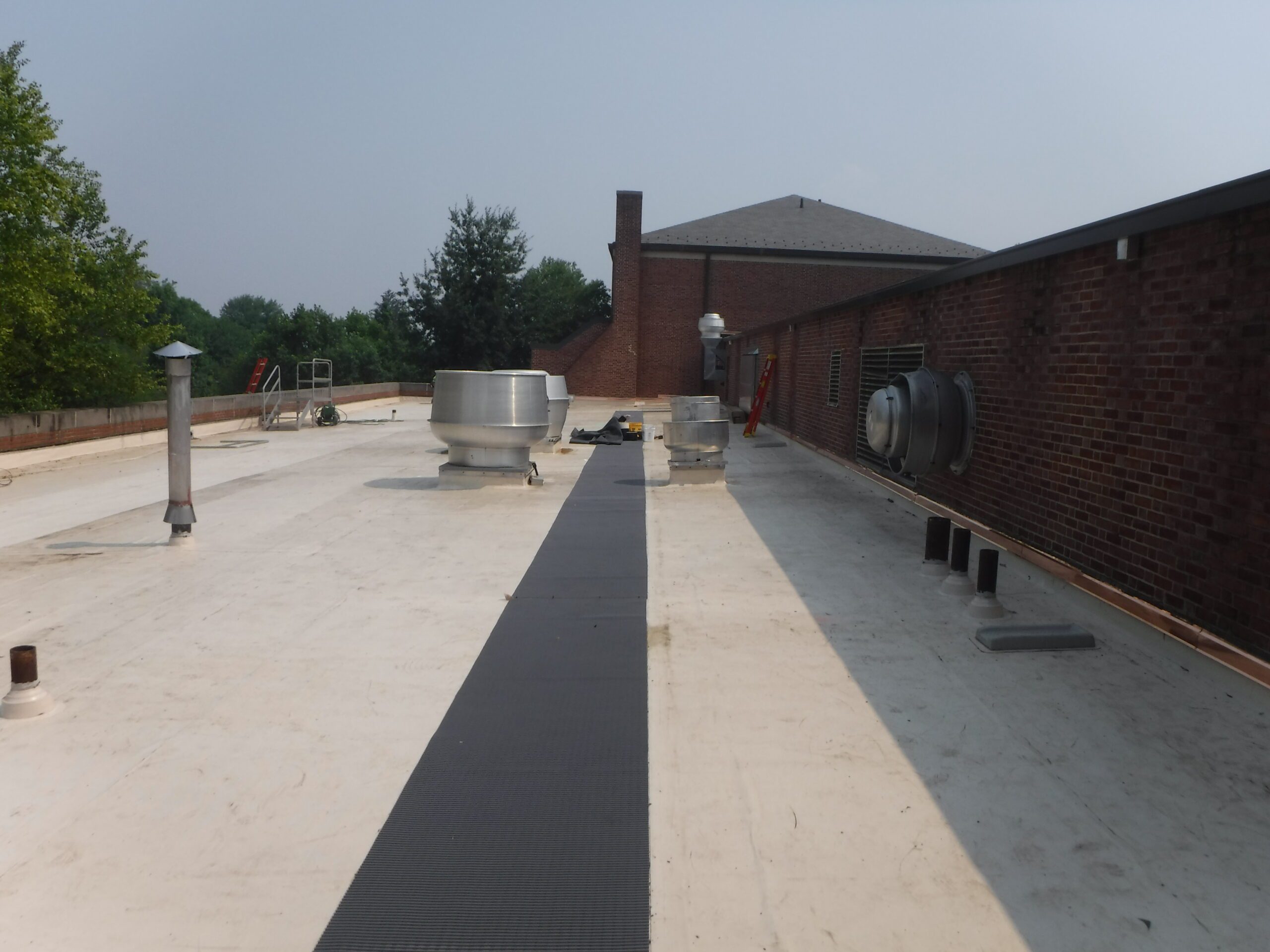
White TPO roof installed by GSM Roofing on Haverford College Alumni Field House
TPO roof on Haverford College’s Alumni Field House.

TPO is a white thermoplastic sheet with seams welded by hot air, so the seam ends up as strong as the sheet. It reflects sunlight, which is why it has become the default on warehouses and manufacturing plants that run air conditioning all summer. It comes in wide rolls, which means fewer seams on a big open roof. At TE Connectivity’s Building 108 in Landisville we replaced a ballasted 45-mil EPDM roof with 60-mil white TPO over R-30 insulation, with a 20-year system warranty.

EPDM roofing

Black EPDM roof installed by GSM Roofing on an elementary school in Lititz, PA
EPDM roof on an elementary school in Lititz, PA.

EPDM is the black rubber roof that has been on commercial buildings for more than 50 years, and it is available in white. It stays flexible in cold weather, it comes in the thickest sheets of the three, and the 90-mil version qualifies for 30-year assemblies. Many of the ballasted roofs we tear off today are EPDM from the 1980s and 1990s that did their job. The Wilson School District’s lower house and pool building received 107,198 square feet of 90-mil Johns Manville EPDM, fully adhered, with a 30-year warranty.

PVC roofing

Large PVC roof installation by GSM Roofing on Philadelphia Premium Outlets
PVC roof installation on Philadelphia Premium Outlets.

PVC is a thermoplastic like TPO, with hot-air welded seams, and it resists the things that shorten the life of other membranes: animal and vegetable oils from kitchen exhaust, chemicals, and water that ponds. It costs more up front. When Franklin & Marshall College replaced the roof on its Ben Franklin dining hall, the kitchen exhaust curbs decided the membrane. We installed 60-mil Carlisle FleeceBACK PVC, fully adhered, over tapered insulation, with a 20-year Carlisle warranty.

Membrane Thickness: 45, 60, 80, and 90 Mil

Thickness is the cheapest upgrade on a roof and the hardest to add later. Sixty mil is the standard on most of the commercial roofs we install. Forty-five mil is sold, and we see it on roofs we are tearing off, but we rarely recommend it for a building the owner plans to keep. Eighty-mil TPO and 90-mil EPDM are for roofs with regular foot traffic, rooftop units that get serviced, hail exposure, or an owner who wants a 30-year warranty, which generally requires the thicker sheet. The difference in cost between 60 and 80 mil is a small share of the project. The difference in service life can be a decade.

How the Membrane Is Attached

The same sheet can be held down four ways, and the choice depends on the deck, the wind exposure, the building use, and what is happening inside.

What Goes Under the Membrane

The membrane gets the attention. The insulation, cover board, and deck underneath decide whether it stays dry and flat.

Insulation. Current energy codes in our region put most commercial replacement roofs at R-30, which we meet with two layers of 2.6-inch polyiso with staggered joints. On top of that goes tapered insulation where the roof needs help moving water to the drains. The new height matters: a roof that had 2.5 inches of insulation now has more than 5. Curbs get raised, edge metal gets taller, and ladders get modified. At TE Connectivity, GSM Industrial rebuilt the wall-mounted ladder to reach the new roof. Rooftop units come off and go back on taller curbs, which is covered on our HVAC curb installs page.

Cover boards and vapor barriers. A cover board between the insulation and the membrane spreads foot traffic and hail loads and gives the adhesive something solid to grab. On the Wilson pool building, which has a wood deck over a natatorium, we mechanically fastened quarter-inch DensDeck Prime to the deck and applied a self-adhered Johns Manville vapor barrier before the insulation went down. At Emory Hill we used ISOGARD HD, a lightweight high-density cover board. Over a pool, a kitchen, or a plant with process humidity, the vapor barrier is not optional.

The deck. Metal, wood, and gypsum decks each take fasteners differently, and a tear-off is the only time anyone sees the deck. We check it for rust, rot, and fastener pull-through before anything new goes down and fix what we find while it is exposed.

Tear Off or Recover?

A recover means leaving the old membrane in place and installing the new roof over it. It saves the tear-off cost and the landfill, and it works when three things are true: the insulation under the old roof is dry, the deck is sound, and there is only one roof there already, since building codes allow two at most. We confirm the first two with an infrared scan and core samples during the inspection, not by guessing. When the insulation is wet, a recover traps the water and the new roof fails early, so everything comes off. The roof replacement page covers the signs that put a roof in that category and what drives the cost either way. For the numbers, see what a commercial roof costs per square foot.

Completed white TPO roof reflecting sunlight on TE Connectivity Building 108 in Landisville, PA

60-Mil TPO Over R-30 at TE Connectivity, Landisville, PA

Building 108 had a ballasted 45-mil EPDM roof over 2.5 inches of EPS insulation. We removed all of it and installed 5.2 inches of polyiso to R-30 and a 60-mil white TPO membrane with a 20-year system warranty. The plant allowed no cranes and no flatbeds on site, every dumpster was tarped for runoff, and our crews stayed inside walkways and fall protection within six feet of the edge. GSM Industrial modified the access ladder for the new roof height and a subcontractor reinstalled 600 feet of lightning protection. The job finished ahead of schedule.
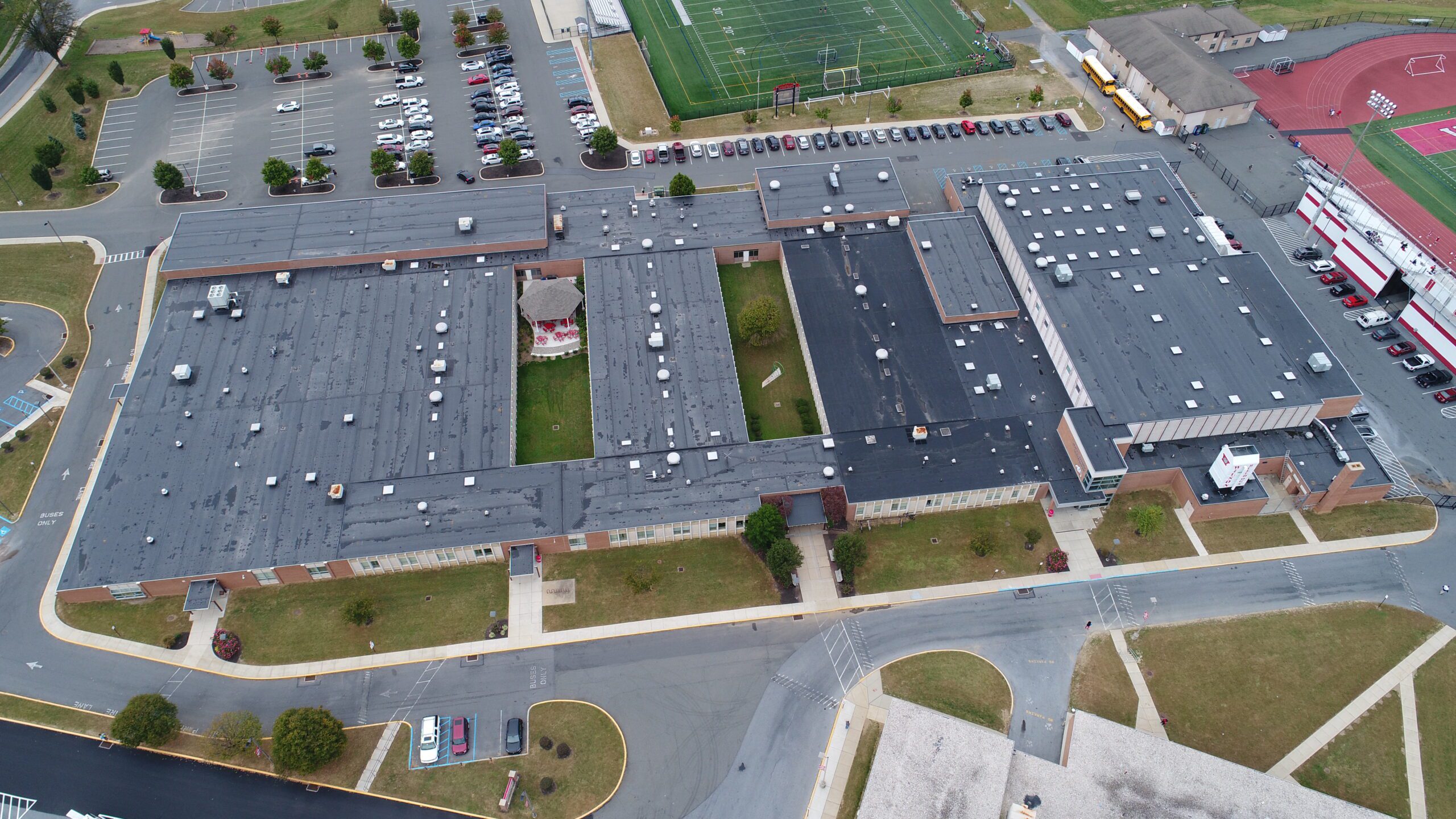
Aerial view of the new 90-mil Johns Manville EPDM roof on Wilson School District lower house and pool in West Lawn, PA

107,198 Square Feet of 90-Mil EPDM for Wilson School District, West Lawn, PA

The lower house and pool building had an out-of-warranty ballasted roof leaking throughout. We tore 87,500 square feet of ballasted EPDM off the lower house down to the deck, fastened two layers of 2.6-inch polyiso to R-30, and adhered a 30-year Johns Manville 90-mil EPDM assembly. The 19,716 square foot pool roof came off down to its wood deck and got DensDeck Prime, a self-adhered vapor barrier, R-30 in adhesive, and the same 30-year assembly. Work started in June so most of it finished over summer break, with alternate walk routes marked for the staff and students still on campus.
Completed tan Carlisle FleeceBACK PVC roof on the Ben Franklin Dining Hall at Franklin and Marshall College in Lancaster, PA

PVC Over a Kitchen at Franklin & Marshall’s Ben Franklin Dining Hall, Lancaster, PA

The exhaust curbs on a dining hall roof vent animal and vegetable oils, which break down some membranes, so this one had to be PVC. We tore off the gravel-surfaced built-up roof without contaminating the new sheet, primed the deck, set 2-inch polyiso and tapered insulation in low-rise foam adhesive, and fully adhered 6,556 square feet of 60-mil Carlisle FleeceBACK PVC in tan. The details are where a kitchen roof lives or dies: 423 feet of wall flashing with copper counterflashing, four soldered stainless scuppers, 140 feet of walkway to the equipment, and rooftop units lowered onto rebuilt curbs. Carlisle issued a 20-year warranty and GSM added a two-year workmanship warranty.

More of our single-ply work: a 160,000 square foot Lancaster manufacturing plant re-roofed to R-30 over live production with an interior containment system under the deck, the Cecil County building that houses a 911 call center, recovered with fully adhered 60-mil EPDM, and The Market at the Wilbur in Lititz, a 30-year Platinum Firestone EPDM roof under terrace pavers on a building that lost its crane access partway through construction.

What the Warranty Covers

A single-ply roof carries two warranties. The manufacturer warrants the membrane, and on a qualifying system the whole assembly, for 20 or 30 years. The longer term generally requires the thicker sheet and the manufacturer’s own insulation, adhesives, and accessories. A no-dollar-limit warranty means the manufacturer repairs a covered failure without a cap, which is the term worth asking for. GSM adds a workmanship warranty on top. Manufacturers only register these warranties when a contractor they have certified installs the system, which is the practical reason the credentials on our manufacturers page matter to a building owner.

The warranty stays in force when the roof is maintained and documented. Unapproved rooftop work, a skipped inspection, or a curb cut by another trade can void it. The Exceptional Roof Protection Plan handles the inspections, the documentation, and the repair coordination so the warranty is still there in year 18.

Working on a Building That Stays Open

Most single-ply roofs we replace are on buildings that cannot close. Over a Lancaster plant with no ceiling grid, we built an interior containment system under the deck to catch tear-off dust before it reached the production floor, then moved 26 tractor loads of material across nearly four acres of roof with crews that ranged from 3 to 20 mechanics depending on the phase. At TE Connectivity we worked without cranes. At the Wilbur in Lititz we lost crane access when the garage went in, so material went up by crawling lift and by hand. School roofs run on the academic calendar and healthcare roofs run on the surgical one. The sequence, the staging, and the smelly parts are planned with your facility team before the first truck arrives.

Why Building Owners Choose GSM Roofing for Single-Ply Systems

We have been installing low-slope roofs in this region since 1946, when built-up roofing was the only option, and we have put down single-ply membranes since the systems arrived. More than 100 of our employees have been with us 25 years or longer, so the foreman on your roof has usually seen every way a seam can fail. Our approach includes:

Single-Ply Roofing FAQs

Which is better for my building, TPO, EPDM, or PVC?

It depends on what sits on and around the roof. TPO is the usual choice for warehouses, manufacturing plants, and offices because it is white, heat-welded, and priced in the middle of the three. EPDM is the choice when you want the longest track record and the thickest sheet, and it stays flexible in Pennsylvania winters. PVC is the choice when the roof sees cooking oils, chemicals, or ponding water, which is why we put PVC on a college dining hall with kitchen exhaust curbs. We will tell you which one fits before we price it.

How thick should a single-ply membrane be?

Sixty mil is the standard we install on most commercial roofs. Forty-five mil is the thinnest sheet sold and we rarely recommend it for a building you plan to keep. Eighty and 90 mil sheets are for roofs with heavy foot traffic, rooftop equipment service, hail exposure, or an owner who wants a 30-year warranty, which generally requires the thicker membrane. The Wilson School District pool and lower house got 90-mil EPDM for exactly that reason.

Can you install a new membrane over the existing roof instead of tearing it off?

Sometimes. A recover works when the insulation under the old membrane is dry, the deck is sound, and there is only one roof there already, since code limits you to two. We check with an infrared scan and core samples before we say yes. At the Cecil County building we vacuumed off the ballast, cut the old EPDM for ventilation, and adhered a new membrane over it. At TE Connectivity and the Wilson schools, the insulation was the problem, so everything came off down to the deck. The roof replacement page explains the signs that mean a recover is not an option.

What insulation does the energy code require on a replacement roof?

In Pennsylvania and the surrounding states, a full replacement generally has to meet the current energy code, which for most commercial roofs means R-30 above the deck. We get there with two layers of 2.6-inch polyiso with staggered joints, often with tapered insulation on top to move water to the drains. The extra height is real: a roof that had 2.5 inches of insulation now has 5 or more, so curbs, edge metal, and access ladders have to be raised with it. At TE Connectivity our sister company GSM Industrial modified the wall-mounted ladder to match the new roof height.

What warranty comes with a single-ply roof?

Two warranties. The manufacturer covers the membrane and, on a qualifying system, the whole assembly for 20 or 30 years depending on the membrane thickness and the components used. GSM covers the workmanship on top of that. Recent examples: a 20-year Carlisle SynTec warranty on the F&M dining hall PVC, a 20-year TPO system warranty at TE Connectivity, and 30-year Johns Manville and Firestone Platinum assemblies at the Wilson schools and the Wilbur Building. Manufacturers register the warranty only when a certified contractor installs the system, and they expect documented maintenance to keep it in force.

Can you replace the roof while the building stays open?

Yes. Most of our single-ply work is on occupied buildings. At a 160,000 square foot Lancaster plant we built an interior containment system under the deck so tear-off dust never reached the production floor. At TE Connectivity the plant did not allow cranes or flatbeds on site, so material went up another way. School roofs are scheduled for summer break, and the Cecil County building kept its 911 call center running through the whole job. We plan the noisy and smelly parts with your facility team before we start.

Does a white roof really lower cooling costs?

A reflective roof lowers the cooling load on a building that runs air conditioning through the summer, and it keeps the membrane itself cooler, which slows aging. How much you save depends on the building, the insulation, and how the space is used. Our white roof vs. black roof article walks through what actually matters for buildings in the Northeast.

Team, I just wanted to send a quick thank you to all of you for your help in getting together the final invoices for Reading and North Temple. You all are the best and it is always a pleasure working with you! Have a great day, Cindy

Cindy Yates