
Tyrone, PA • Vermont Gray Natural Slate • Copper Specialty Metals • National Register of Historic Places

| PROJECT AT A GLANCE | |
| Client | St. Matthew Roman Catholic Church, Tyrone, PA |
| Built | 1886 | National Register of Historic Places, 1993 |
| Slate System | Vermont Gray blend, fading and non-fading | Approx. 50 years old |
| Base Scope | 100 sq ft scattered slate repairs across roof field |
| PCO 1 | 30 Alpine PD-10 LC Copper snow guards replaced |
| PCO 2 | 75 LF custom 16-oz copper ridge cap installed |
| Client Savings | Significant savings achieved through strategic scheduling of snow guard repair |
| Completed | April 2026 |
| Lead Installer | Dave Hoffer, Master Pro Certified | Cole Essel, Apprentice |
| Referred by | R.H. Marcon |
The first thing Rob Nauroth noticed was the silicone. A roofing estimator with GSM Roofing out of Ephrata, Pennsylvania, Rob had climbed onto the slate roof of St. Matthew Roman Catholic Church in Tyrone, PA for an initial assessment in early 2024. The church had stood on Cameron Avenue since 1886. It had been listed on the National Register of Historic Places since 1993. And somewhere in the years between then and now, someone had dragged a caulk gun across its Vermont Gray slate and called it a repair.
That single bead of silicone told Rob everything he needed to know about what had been done to this roof. Not because caulk is unusual. Because a specialist recognizes it immediately for what it is: evidence that the previous contractor did not understand how natural slate works. And on a 140-year-old National Register landmark in central Pennsylvania, the gap between someone who understands slate and someone who does not is the difference between a roof that lasts another century and one that quietly destroys itself from the inside.
St. Matthew’s had been referred to GSM by R.H. Marcon. It would become far more than a repair project.
Natural slate does not keep water out through seals. It keeps water out through geometry. Each tile overlaps the course below by a precise measurement. Water runs down the face of one tile and onto the face of the next, each course carrying it further down the pitch until it clears the eave. The system works because of the overlaps, not despite the gaps. There are no gaps that need sealing. The geometry is the seal.
When a contractor who does not understand this encounters a cracked slate, silicone caulk is the predictable response. It looks like it is doing something. It is not. Silicone applied across a slate joint traps moisture behind the seal instead of shedding it. It bonds to adjacent tiles, making future proper repairs harder. It hides the crack while the water finds a new path. The leak does not stop. It relocates. The roof deteriorates faster than it would have without the repair, and the next contractor who arrives inherits both the original problem and the compounding damage. This is not a rare edge case. It is one of the most common ways a historic slate roof in Pennsylvania gets ruined.

Head lap is the distance by which each slate is covered by the course installed two rows above it. It is not an installation refinement or a quality upgrade. It is the primary engineering requirement that makes a slate roof watertight. The National Slate Association’s installation manual specifies minimum head lap dimensions for every roof pitch, and the reason is straightforward: when head lap is correct, water has no path through the system. When it is insufficient, every rain event is an opportunity for water entry, especially under wind-driven conditions.
In sections of the St. Matthew’s roof, the required head lap was simply absent. Slates had been laid without adequate overlap, leaving joints exposed. There is no patch for this. No sealant corrects it. The only response is to remove the affected courses and reinstall them to the proper geometry, which is exactly the kind of work that requires someone who actually knows how slate is installed. A generalist does not know what they are missing because they do not know what to look for.


With the diagnosis complete, the work began. Dave Hoffer, Master Pro Certified Installer, and his apprentice Cole Essel addressed approximately 100 square feet of scattered slate repairs across the roof field, matching each replacement piece to the existing Vermont Gray blend and reinstating proper installation geometry in every affected course. Matching scattered repairs on a 50-year-old Vermont Gray blend requires knowing how this stone ages, which pieces will read as belonging and which will read as patches for decades to come. Dave knows. That knowledge is why he was there.
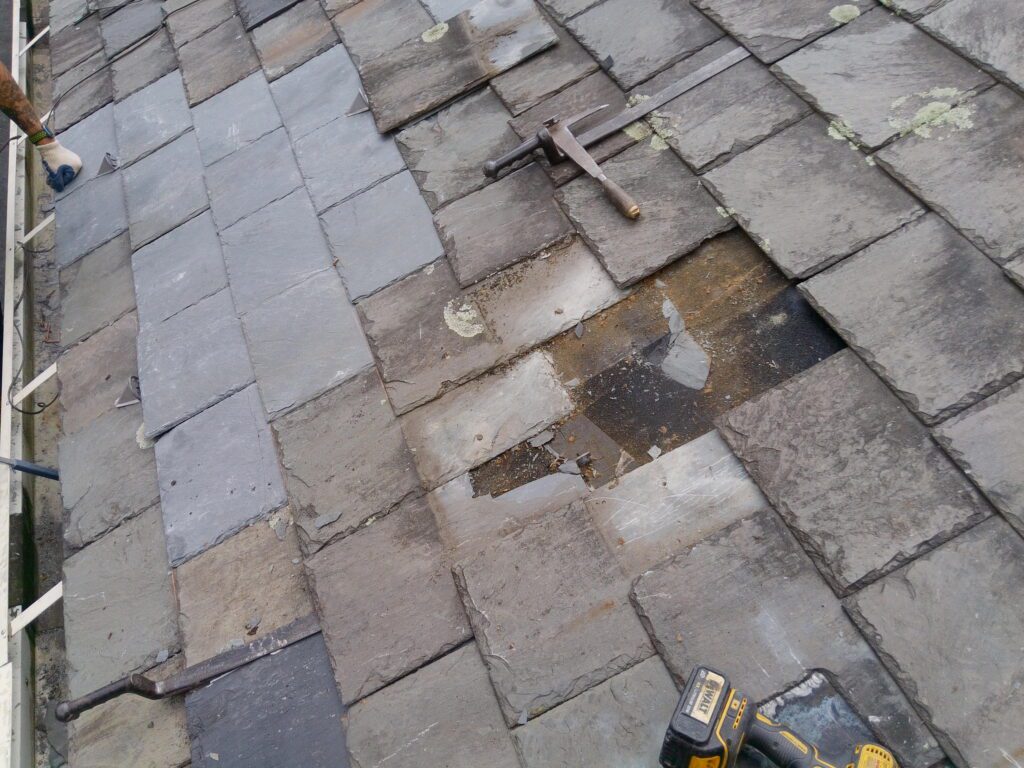
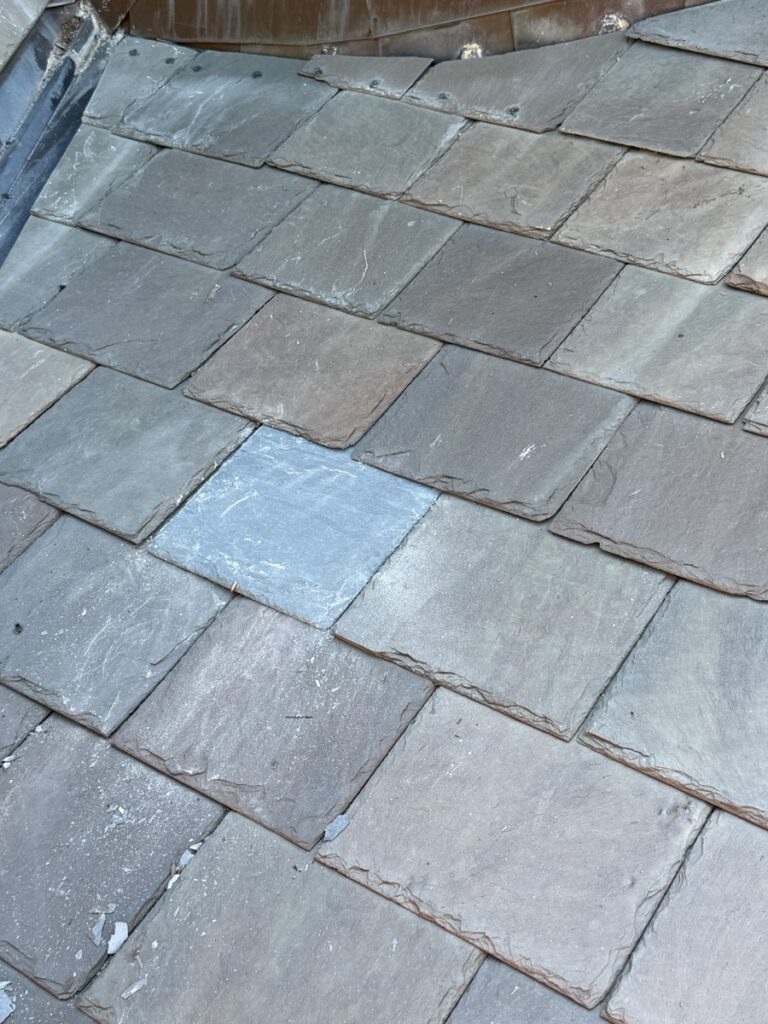
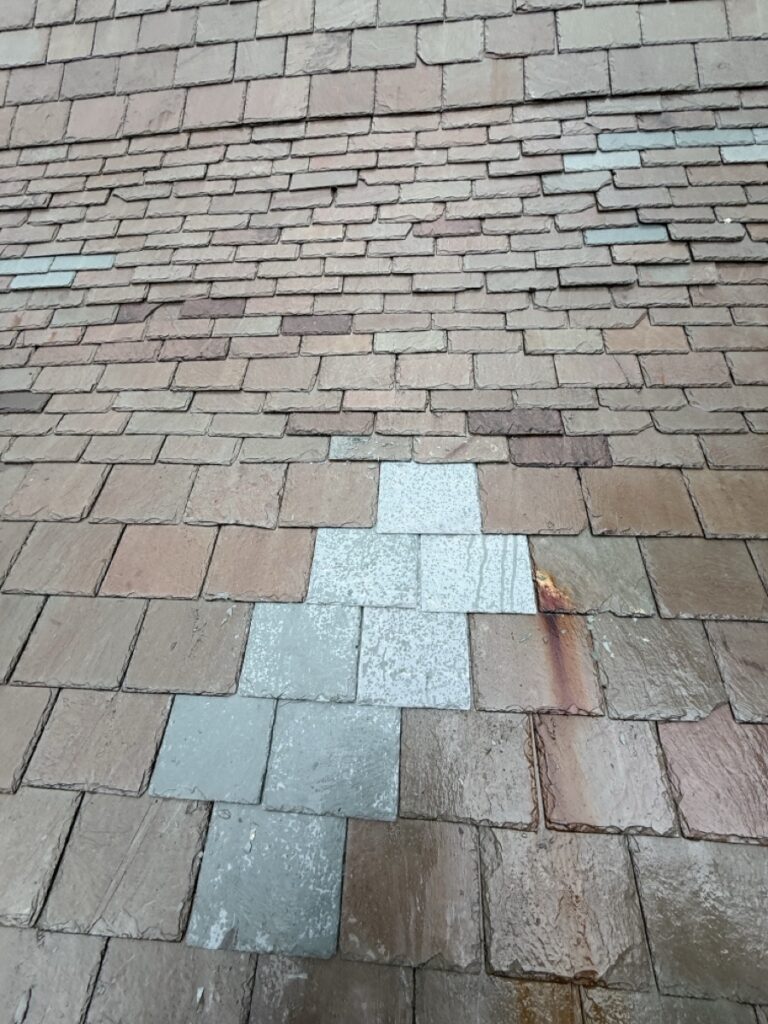
While on-site, Rob identified 30 Alpine PD-10 LC Copper snow guards that had failed over the winter. At that point, he had a choice, and the choice he made is worth understanding because it illustrates something fundamental about how GSM operates.
He could have submitted a proposal for a return visit. Instead, he did the math out loud and handed both numbers to the parish.
Option 1: Perform the snow guard replacement now, while crews and the lift were already mobilized. A fraction of the alternative cost.
Option 2: Return for a dedicated visit after the current project closes. Roughly two and a half times more expensive, because mobilization, lift rental, and out-of-town expenses do not disappear between projects.
The parish chose Option 1. They saved thousands of dollars. Not because GSM discounted the work. Because Rob told them something that most contractors have a financial incentive not to say: when the equipment is already there, the marginal cost of additional work is a fraction of what it costs to come back. Transparency like this is not a sales approach. It is what it looks like when a contractor treats a client’s budget as seriously as their own.
“Let’s do Option 1… You are a great man.”
St. Matthew Roman Catholic Church, Tyrone, PA

Rob also proposed the installation of 75 linear feet of custom-fabricated 16-oz copper ridge cap along the main church roof, and the way he explained it to the parish says as much about GSM as the proposal itself.
He did not say: it seals the ridge. He said: copper at the ridge is a natural biocide. When it rains, copper ions are released and travel down the roof surface. Those ions inhibit the growth of moss, algae, and lichen at the source. On a natural slate roof, organic growth is not a cosmetic problem. Lichen lifts tiles. Moss retains moisture. Both accelerate the deterioration of a roofing system that, properly maintained, should last another century. A copper ridge cap works passively and continuously to prevent this, with no maintenance required.
He gave the parish the full technical picture, presented a transparent total investment for the work, and made clear there was no pressure to decide. An informed client who says yes to a copper ridge cap understands what they are buying. An informed client who says no made a real decision, not a pressured one. Either outcome serves the relationship.
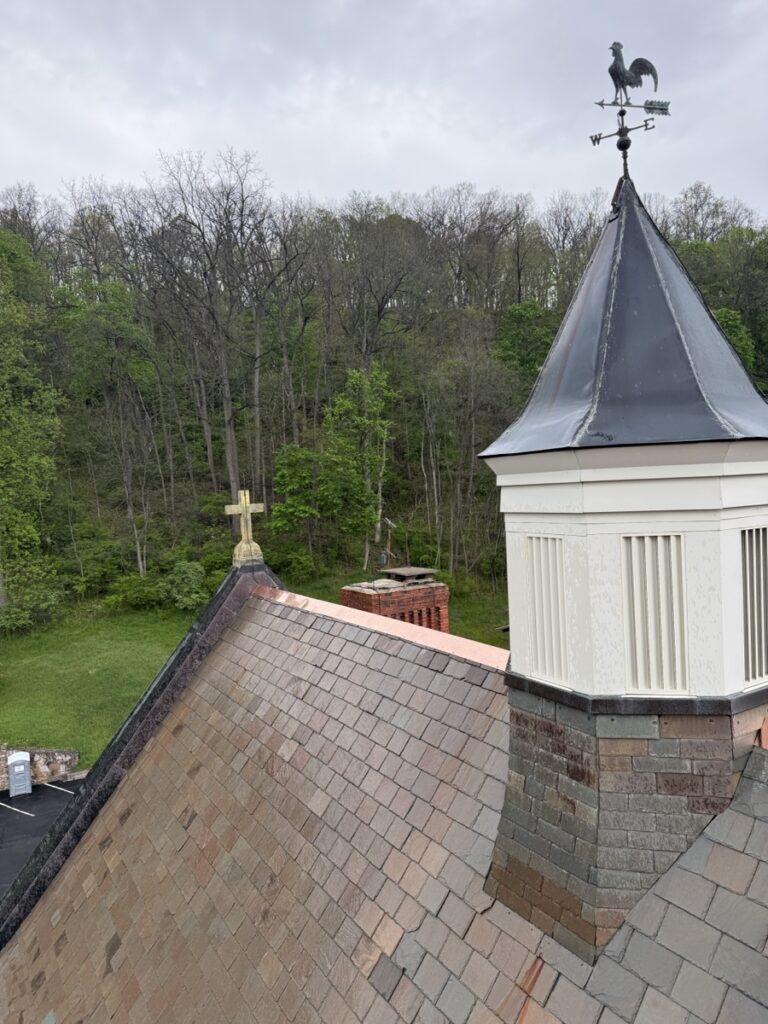
Dave Hoffer holds Master Pro Certified Installer credentials, the highest designation the slate industry issues. Cole Essel, his apprentice, worked beside him for every hour of the St. Matthew’s project.
Picture the two of them on that roof. The Vermont Gray field stretching out in both directions, a mix of fading purple-gray tiles and darker non-fading ones, the pattern the stone made when it was quarried half a century ago. Finding a matching piece for a scattered repair on a 50-year-old Vermont Gray blend is not a matter of ordering slate and nailing it down. It requires knowing how this particular stone ages, how the fading slates are going to look in ten years relative to the non-fading ones, and how to set the replacement so the geometry is right even when the surrounding field is not exactly where the original installer intended it to be. That knowledge does not live in a manual. It lives in the hands of the person doing the work, and it transfers from one pair of hands to the next through exactly the kind of apprenticeship playing out on this roof.
GSM has been doing historic slate roofing in Pennsylvania since 1946. The institutional memory in that span of time, the accumulated knowledge of how slate from different quarries behaves, how Pennsylvania winters punish a poorly installed ridge, how the head lap requirements for a steep Gothic-pitch church roof differ from those of a four-pitch institutional building, does not exist in any other form. It exists in the people. The master teaches the apprentice. The apprentice becomes the master. The roof that Dave and Cole repaired today will be evaluated and re-repaired by someone who learned from one of them. For a National Register property in Blair County, Pennsylvania, that continuity is not a peripheral benefit. It is the entire point.
When the repairs at St. Matthew’s were finished and the lift was demobilized, Rob Nauroth did something outside the scope of any proposal.
He committed to coming back. Not when called. Not when something breaks. Every April, he will return to St. Matthew’s, attend Mass, and perform a professional roof evaluation. He will document what he finds, provide the parish with a condition report, and give them a maintenance budget projection so that no repair ever arrives as a surprise. He has already delivered an initial budget recommendation for the ongoing care of the slate system.
This is not a maintenance contract. There is no recurring invoice. It is a personal commitment made by a craftsman who climbed onto a 140-year-old roof in Tyrone, Pennsylvania, understood the weight of what he was standing on, and decided the building deserved someone who would keep showing up for it.
A properly installed and properly maintained natural slate roof can last 150 years or more. The Vermont Gray on St. Matthew’s, now correctly repaired, fitted with copper snow guards, and protected at the ridge by a copper cap releasing biocide ions with every rainfall, is positioned to do exactly that. The next generation of this church’s congregation will not have to worry about this roof. Not if someone keeps showing up every April. Rob will.
There are roofing contractors who have installed slate. There are contractors who have repaired it. And then there is GSM Roofing: a family-owned company founded in Ephrata, Pennsylvania in 1946 that has been working on historic structures long enough that the National Slate Association asked them to help write the installation standard that the rest of the industry follows.
The historic slate projects in GSM’s portfolio include the home of President James Buchanan at Wheatland in Lancaster, PA; the Mansion at Cabrini College; the Maytown Reformed United Church of Christ; and now St. Matthew Roman Catholic Church in Tyrone. Across nearly 80 years of historic roofing work in Pennsylvania, New Jersey, Delaware, and Maryland, few contractors have built the depth of specialty knowledge this work demands.
The work done before GSM arrived at St. Matthew’s cost the parish more than the repairs GSM performed. It always does. Silicone on a slate roof is cheap. The damage it causes is not. The lowest bid on a historic roofing project is not the conservative choice. It is the expensive one, paid in increments over years, often by the next property manager, sometimes by the next generation of congregation. Hiring a specialist is the practical decision. On a National Register landmark, it is also the only defensible one.
GSM’s credentials in this space are specific. The company contributed to the National Slate Association’s updated slate installation manual because GSM’s craftsmen helped write the standard the industry follows. Master Pro Certified Installers perform the work on every historic slate project. The portfolio spans National Register of Historic Places properties, historic churches, universities, landmark estates, and government buildings across Pennsylvania, New Jersey, Delaware, and Maryland. The specialty metals capability, custom copper fabrication, copper snow guards, copper ridge work, custom flashings, is built in-house, not subcontracted. And the company is family-owned, operating from Ephrata, Pennsylvania, the same as it has been since 1946. Nearly 80 years is a long time to stay accountable to a single standard. GSM has.
Managing a historic slate or specialty roof in Pennsylvania, New Jersey, Maryland, or Delaware?
GSM Roofing has served historic properties across the Mid-Atlantic since 1946. Our Master Pro Certified Installers specialize in natural slate, copper specialty metals, and the kind of long-term stewardship that landmark buildings deserve.
The most reliable indicator of improper slate roof repair is visible caulking or sealant applied to slate surfaces or joints. Silicone caulk on a natural slate roof is almost always evidence of unskilled workmanship. It conceals cracks without addressing the cause, traps moisture behind the seal, bonds to adjacent tiles, and makes future proper repairs harder. Other signs include slates installed with insufficient head lap (the overlap that makes the roof watertight), mismatched replacement tiles that indicate material was sourced without regard for the existing system, and leaks that return repeatedly in the same locations despite multiple repair attempts. If you have seen caulk on a historic slate roof, the question to ask is not what it was fixing. The question is what it was hiding and how long it has been hiding it.
Head lap is the distance by which each slate tile is covered by the course installed two rows above it, and it is the primary mechanism that makes a slate roof watertight. The National Slate Association’s installation manual specifies minimum head lap dimensions for every roof pitch. When head lap is correct, water has no path through the system. When it is insufficient, every rain event creates an opportunity for water entry, particularly under wind-driven conditions. Correcting a head lap deficiency is not a standard repair. It requires removing and reinstalling the affected courses from the top down to restore proper geometry. There is no sealant that substitutes for correct installation. This is the single most common foundational error made by contractors who work on slate without genuine specialty training, and it is the reason historic slate roofing requires a specialist, not a generalist.
Silicone caulk damages a natural slate roof because it disrupts the water-shedding geometry the system depends on and traps moisture against the stone rather than allowing it to drain away. Natural slate keeps water out through the precise overlap of each tile by the course above it, not through seals or coatings. Caulk applied across a joint creates a surface bond that holds moisture against the slate and the substrate, accelerates the deterioration of the surrounding material, and bonds to adjacent tiles in ways that make future proper repairs significantly more difficult. The underlying crack is cosmetically hidden while the damage continues beneath it. In most cases, a silicone repair on a historic slate roof creates more damage than it prevents. Removal and proper repair of the affected area is the correct response.
Alpine PD-10 LC Copper snow guards are individual pad-style snow retention devices designed for steep-slope natural slate and specialty roofing systems, and copper is the preferred material for historic church roofs because it is compatible with existing slate and metalwork, does not create galvanic corrosion risk, and weathers to a patina that integrates naturally with the historic character of the structure. Snow guards prevent the sudden shedding of accumulated snow and ice loads from steep pitches, protecting pedestrians, landscaping, lower roof sections, and architectural elements at grade. On an active church with regular foot traffic around its perimeter, snow retention is a life-safety consideration, not an upgrade. Copper units are specified on National Register and other historic properties because they perform at the highest level over the multi-decade timelines these buildings require.
A copper ridge cap on a natural slate roof releases copper ions during rainfall that travel down the roof surface and inhibit the growth of moss, algae, and lichen, providing ongoing passive protection against one of the most common causes of long-term slate system deterioration. On a slate roof, organic growth is not merely cosmetic. Lichen adheres to the stone and physically lifts tiles over time. Moss retains moisture against the surface, accelerating weathering and softening the substrate. Both create conditions that compromise the watertight integrity of the system. A copper ridge cap addresses this at the source without any maintenance intervention required. The copper patina that develops over time does not diminish this effect. Custom-fabricated copper ridge caps are installed using period-appropriate techniques on historic structures to maintain architectural integrity while providing a modern performance advantage.
Yes. GSM Roofing has extensive experience on properties listed on the National Register of Historic Places and works regularly with preservation boards, religious institutions, universities, and historic property managers across Pennsylvania, New Jersey, Delaware, and Maryland. Past historic projects include the home of President James Buchanan at Wheatland in Lancaster, PA; the Mansion at Cabrini College; the Maytown Reformed United Church of Christ; St. Matthew Roman Catholic Church in Tyrone, PA; and numerous other historic churches, institutional buildings, and landmark estates. GSM contributed to the National Slate Association’s updated slate installation manual and employs Master Pro Certified Installers with specific expertise in historic slate restoration, copper specialty metals, and the material and documentation requirements that National Register properties involve. GSM has been doing this work from Ephrata, Pennsylvania since 1946
Dylan, Seth, Tom, and Pete did a nice job on the APGFCU Bel Air Garage shingle re-roof. Just wanted to say thanks for all your assistance on this project. The roof looks great!

